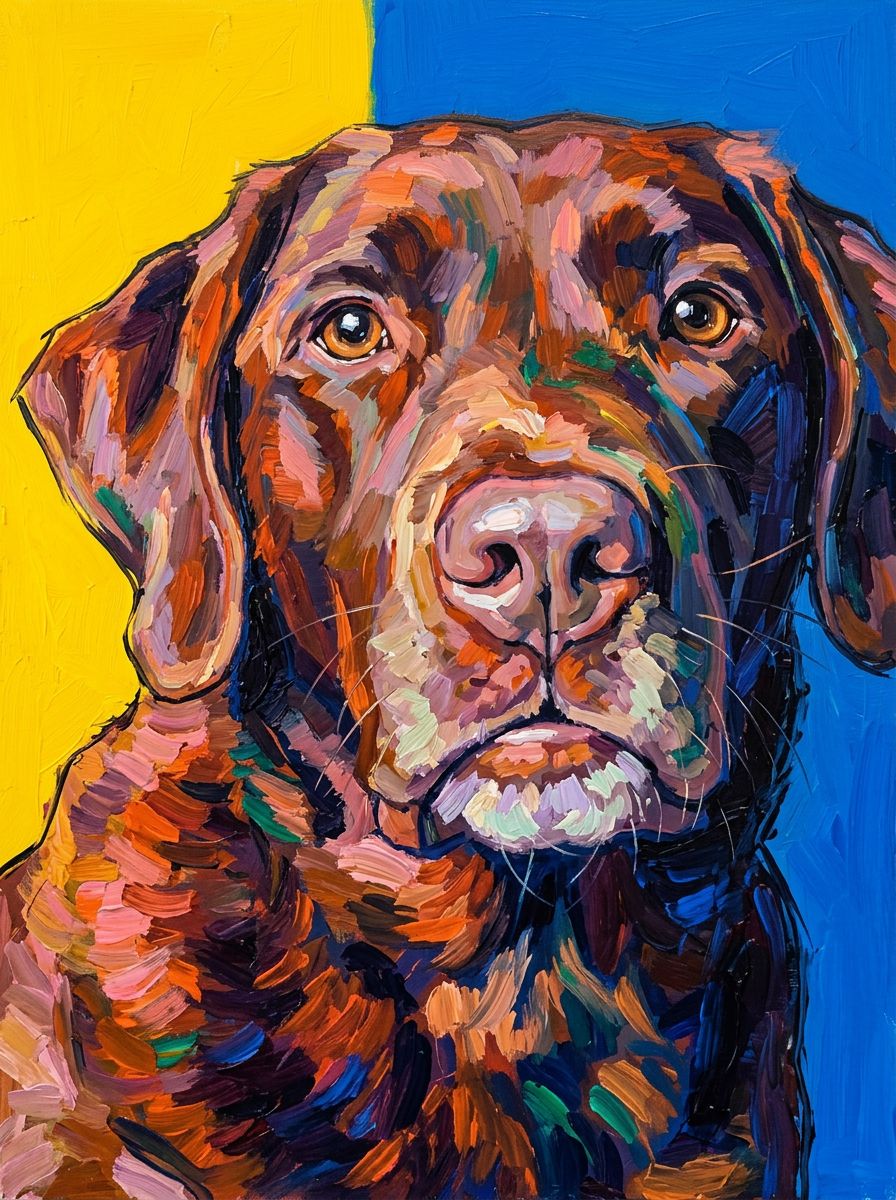
The Labrador Retriever has been one of America’s favourite dogs for decades, and it is easy to see why: a kind face, a broad head, soft ears and eyes that follow you around the room. That simple, strong shape is perfect for a Fauvist portrait. There is no busy coat pattern to fight with, so the colour can do the talking.
How we paint a Labrador
A Labrador’s coat is short and shiny, so light slides over it in big, clear areas. We paint those areas as bold blocks of colour, warm where the light hits and cool in the shadows.
Black Labs stay very dark: blue-black and violet-black, with strokes of cobalt and emerald where the coat shines. They never turn grey or brown. Yellow Labs become warm mid-tones of ochre, orange and soft pink, with a pale cream muzzle. Chocolate Labs turn into deep warm browns lit with orange and rose.
The eyes and nose keep their real colour from your photo. A Lab’s gentle, slightly sleepy look is what makes it your dog, so we keep the eye shape and eyelids exactly as they are.
Photo tips for a Labrador
Black Labs are the hardest dogs to photograph. Take the photo outside in soft daylight or next to a bright window, never in a dark room or with flash. You should be able to see the eyes clearly in the photo.
Hold the phone at your dog’s eye level, not from above. Wait for a calm moment after a walk; a Lab with its mouth closed or slightly open looks best. Crop close: the face should fill at least a third of the photo.
About the breed
Labradors come from Newfoundland, where fishermen used them to pull in nets and bring back fish, and were later developed in Britain as retrievers. They are medium to large dogs, usually 55 to 80 pounds, and are known for being friendly, patient and eager to please, which is why so many work as guide and assistance dogs.
Your Labrador Retriever, painted wild.
The Fauvi shop opens soon. Enter Pet of the Day for a free digital portrait you can download, or join the list to hear first.